


Domus Demetrius
Until the latter years of the sixteenth century, the corpses of the fallen were mostly left unclaimed on the blood-soaked soil where they fell, but this changed when it became evident that the Heretic Legions were expending great effort to claim the bodies of those sworn to the Church. The Synod of Strategic Prophecy concluded they were being transported to Hell for purposes too hideous to contemplate, and thus the Council of Saints was petitioned to send one of the legendary Paladins into Hell itself to discover what unholy perversions were afoot. It is said that Paladin Gérin fought his way down through the Inferno to the very gates of Dis before returning to the Castel Sant’Angelo to report his findings. What he said has never been recorded, but soon after the Demetrian Order of Reclamation was instituted to recover as many bodies as possible from the front lines.
These bodies were transported along what became known as “Corpse Rails”, thanks to the viscous trails of bodily fluids that indicated the passing of such deathly rolling stock. Given the ferocity of the fighting, the smaller depots were soon overwhelmed and a far larger structure was constructed in 1809 to house and process the dead: the Domus Demetrius. Known colloquially as the “Body Barn”, it is a vast, grimly industrial structure constructed over the ruins of an ancient fortress of the Templar Knights in the Amanus Mountains, which in turn had been built upon a Byzantine fortress that had been razed by the Great Seljuk Empire prior to the opening of the Jerusalem Hellgate.
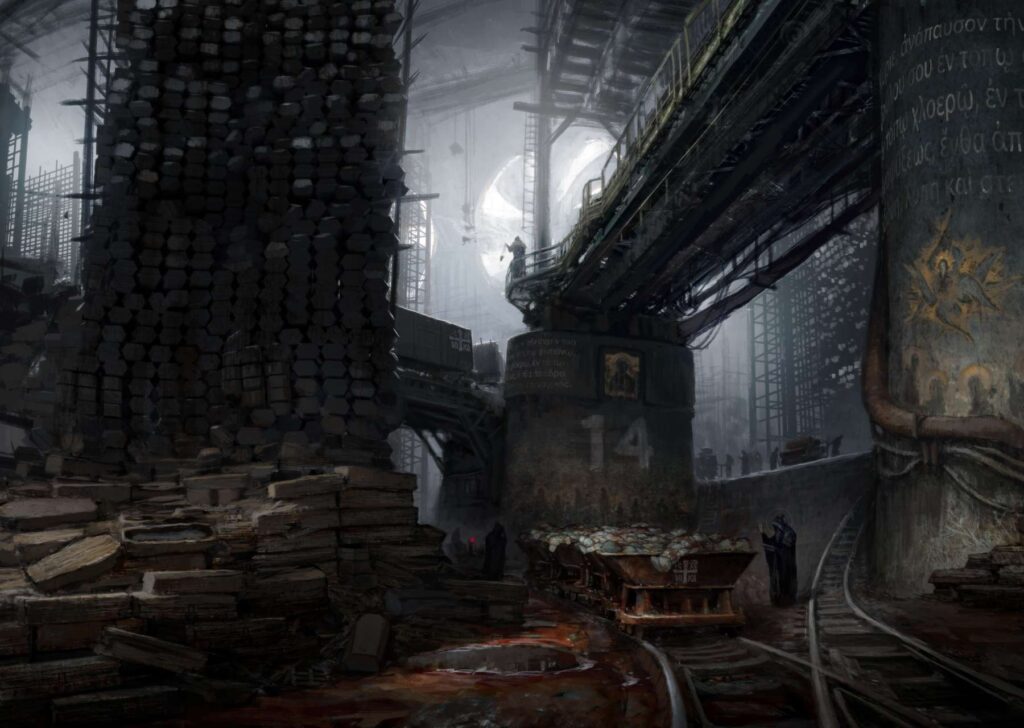
The Domus Demetrius is a sprawling complex of colossal ironframed structures filled with corpse-cranes, row upon row of soaring embalming silos, and vast storage bays of coffins and body bags. When the bodies of the fallen arrive, they enter via the Great Exonarthex, which contains the towering Ciborium Demetrius, a columned structure said to contain the earthly remains of Saint Demetrius, one of the many martial saints who watch over fallen soldiers. A perpetual rain drizzles from the underside of the Ciborium – it may just be powerful disinfecting solutions, but the potent reek of myrrh leads many to believe it is the body of the saint purifying those who pass beneath him in preparation for their onward journey to Heaven. Within the structure, the fallen are treated with great reverence by the Demetrian Monks, who recite the words of the Corpus Benedictionis to render them unusable by Hell. When the bodies complete their purifying journey, they are shipped out to the corpse caves of Crete in rusted hulks that are frequently sunk before reaching their destination.
In recent years, as the war against Hell has intensified, the resources needed to maintain the Domus Demetrius have largely been diverted elsewhere. Although the Corpse Rails still run, bringing a never-ending supply of the dead, the ability of the monks to process them has fallen sharply, to the point where the growing mounds of corpses are like unto mountains themselves, the largest of which press against the structure’s roof, many hundreds of yards above the blood-slick tiles. Rumours persist that voracious packs of carrion feeders have penetrated the forgotten undercrofts of the ancient ruins upon which the facility was built, tunnelling up into the heart of the corpse mountains to slowly devour the fallen from within. The Demetrian Monks vehemently deny this, pointing to the immovable iron doors bearing archaic sigils of the Sultanate that seal the catacombs. What lies beyond these portals is unknown, but none stationed here are in any hurry to find out.