


Leper-Pilgrims of the Sacred Affliction
“Sing praise unto the Lord, my brothers and sisters! Exalt the numbness and the falling away of flesh He deems fit as He frees us of our sin. Cherish the pocks and grooves His divine fingers shape, for in thy carvings does He show the path to purgation. Pray that this affliction most sacred shall cleave unto thee until thy soul is fit for heaven. Suffering is the Lord’s most sage council – indeed, did He not reserve it most fulsomely for His only son? Lo, for blessed are we that should follow in His footsteps, with holy crooked toes and lids unable to shield our eyes from the truth of His love.”
– Prophet Solon, Proclamations of His Gift
Even a worm will turn.
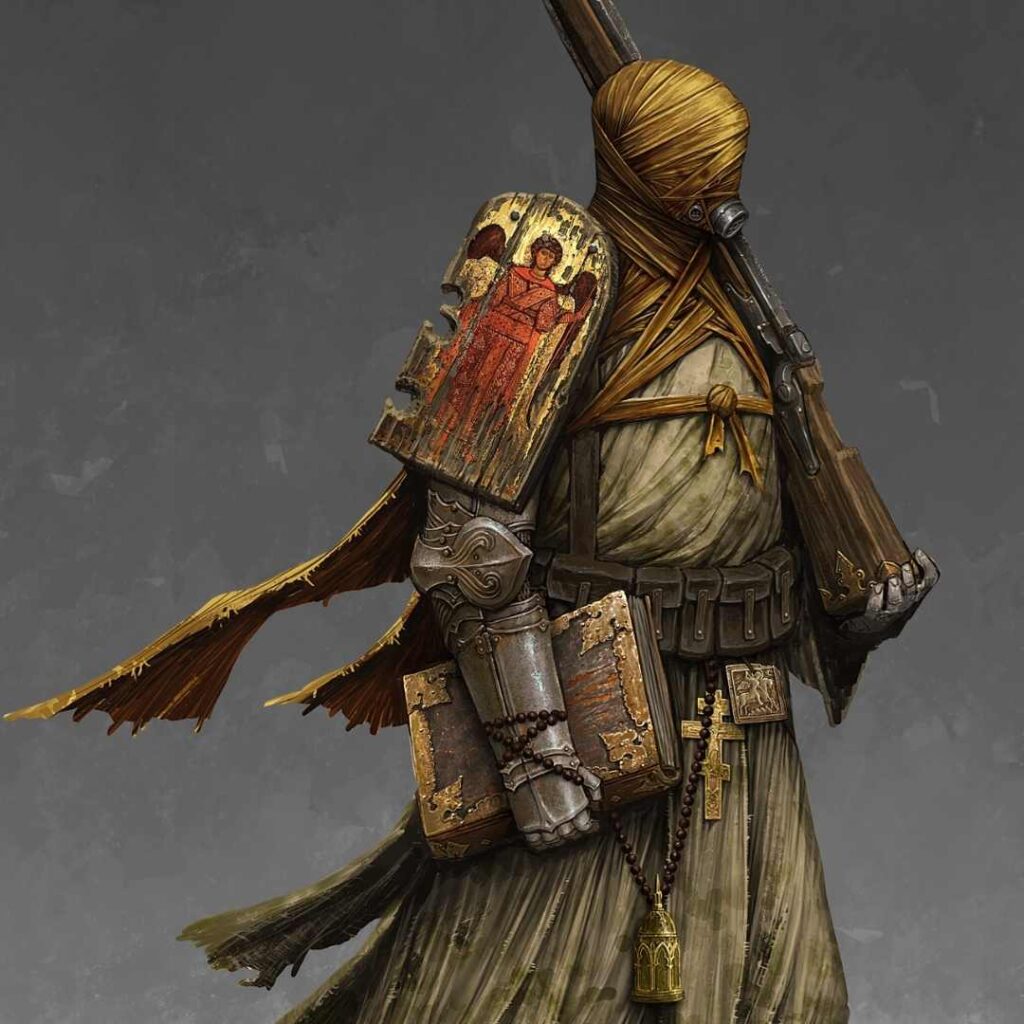
It is by the clamour of bells and hymns that they shall be heard. It is by the iron perfume of myrrh-soaked scabs, leeching up from brazen censers that they shall be smelled; and it is by the heavy sprinting of sickly bodies, barely contained by yellowing bandages and the dance-clatter of holy icons, that they shall be seen. But it is by their hands, locked in blessedly arthritic union around the throat of the heretic, that they shall be known. They are pain and piety, they are church and trench, they are lepers and pilgrims. Amassed as the baying throngs of the Processions of the Sacred Affliction, the Leper-Pilgrims are the bloodied knuckles of Christendom, all-too mortal bodies and minds reshaped over centuries in the crucible of the Great War.
Communities of faithful refugees dispossessed by conflict, decreed “sacred processions” by papal bull, have official records dating back to the Wars of Triclavianism in the 13th century. However, the first true Procession of the Sacred Affliction coalesced at the onset of the Corpse Wars, led by the now revered and legendary Prophet Solon. Once the Prince of Decay Beelzebub unleashed the Black Grail across Europa, innumerable caravans of the sick and dying fled their festering homesteads and clogged the arteries of the continent’s trade routes. Solon’s flock, most grievously blighted with leprosy and the sicknesses that it cultivates thereafter, were one of the many to be denied passage through townships due to the fear of spreading infection. Close to death and outraged by their fellow Christians’ selfishness, the Prophet sought martyrdom on behalf of his followers.
To the procession’s dismay, Solon and his fellow lepers shut themselves in a nearby tomb to perish, and called upon his flock to uncover and parade their remains through the town gates seven days later to demonstrate the consequences of the town’s refusal.
However, when those seven days passed and the tomb was opened, the Prophet and his followers emerged hale, strong, and very much alive. They each praised God for the miraculous visit of the Blessed Mary, who bathed their flesh and bade them bear their afflictions as a gift from the Lord: each pockmark a sign, each lesion a lesson, that they might foster the strength of body and soul needed to defeat the forces of Hell. Overcome by holy joy, the pilgrims immediately departed in all directions to spread the good news as far as their damaged legs would take them, while Solon himself travelled across North Africa, leaving behind many more processions in his wake.
In the decades and centuries to come, the Processions of the Sacred Affliction embraced Solon’s Miracle not simply as a figurative sentiment of “pain makes you stronger”, but rather a command to mobilise and fulfill their destiny. They are to, quite literally, defeat the forces of Hell through displays of zealous strength and fearlessness. Followers of the Lord from all corners of Creation travel to join the raucous glory of the Processions, often enamoured by the message that whatever ailments they carry are a sign of God’s love rather than a punishment. Perhaps most surprising to many is the warmth and readiness with which the Processions accept would-be pilgrims. But then, each member of the Procession remembers well the conditions that saw them seek their roving caravans, whether it be agonies of the flesh, mind, or reputation.
While each Procession boasts unique initiation rituals, all honour the Rites of Pure Tzaareth.
The Rite begins with each aspirant confessing both sins and suffering to the Lazarist-Castigators. Once this first step is complete, the oft-weeping aspirant then walks through the assembled audience of the rest of the Procession, with each pilgrim reaching out to them and offering words of comfort and community under God. Only when all in the Procession have welcomed the aspirant does the walk end at the feet of the Lazarist Prophet, who has taken this time to engrave the postulant’s confessed sins into a millstone. The aspirant binds the millstone to their body, and the rites are completed with the gift of a virtue name, a new identity to herald their path to Heaven as Leper-Pilgrims.
Such intimacy with their fellow sufferers invariably leads to the spreading of some physical sickness, but this is considered a small price to pay for unity and salvation. Rarely, the Wheel of Fortune turns that this communal blend of Afflictions blooms fully across a Leper-Pilgrim’s body, with no part left untouched by the Lord’s will. These fated souls are racked with such suffering that no means of mortal injury could compare, whether by blade or flame, and they are filled with the inviolable wrath of God. Unlike other Pilgrim Processions, there are truly no limits to the Procession of the Sacred Affliction’s forgiveness, provided one’s commitment to redemption is true and unwavering. For those that do misstep, the Lazarists loving nature grants the transgressor a final chance at atonement amongst the ranks of Ecclesiastic Prisoners.
When a Leper-Pilgrim takes to the killing fields of No Man’s Land, they are a vision of heavenly violence. The methods they choose to deliver the Heretics unto the Lord can differ across Processions. Many, such as the Marian Processions, choose to bathe the battlefield in fire from improvised flamethrowers and hurled Molotov cocktails, before they dispatch smouldering survivors with bayonet or polearm. Others, such as the Holy Caravan of Saint Dunstan, take up smithing hammers and hefty flails forged with spiked bells, bludgeoning their foes ruthlessly and nailing their feet to the ground. Those that follow the wandering knightly warbands of Saint Lazarus take up swords and shields in the tradition of their long-lasting allies.
Irrespective of their weaponry, Leper-Pilgrims often favour elaborate assemblies of holy icons for armour over standard plate or mail.
They believe the countenance of Blessed Mary and other patron saints is able to turn away ballistics designed to pierce even machined armour. More common still are those who eschew protection altogether, instead leaping across the trenches in simple ragged vestments, unhindered by unnecessary weight. The signature method of murder used across all Processions of the Sacred Affliction comes in the form of their heavy millstone, which is removed from their bodies (the only time one is permitted to do so) and tied around the necks of their bested foes. Many are the heretics who drowned in the mud beneath a millstone’s weight, their last living moments filled by the ecstatic recounting of sins, warbled or barked through mouths full of hallowed rotten teeth and spittle-strewn bandages.