



Writing A Custom Campaign: Malian Scouring
by Sammie Dae
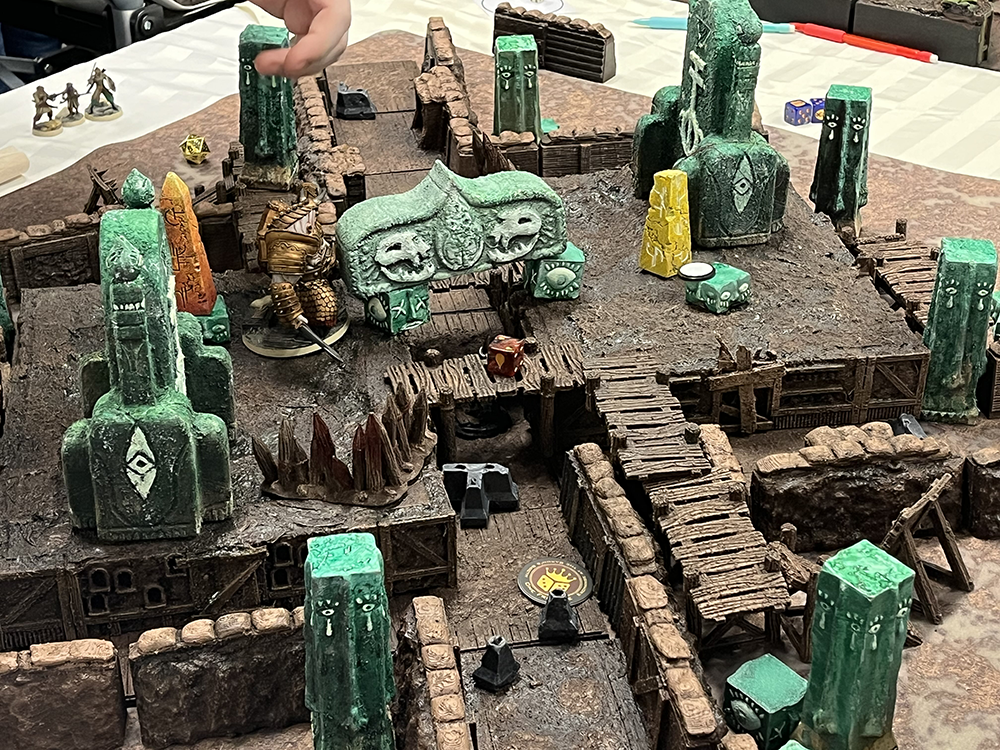
“But thus far, Mammon’s plans to sweep across the northern coast of Africa all the way to Mali and Axum has been frustrated.”
Like Mammon, I remember reading the quote above with curiosity and frustration. Where is the rest? You can’t just bring up Mali and not talk about Mali! You can’t just write “GOLDEN EMPIRE OF MALI” on the map with a big arrow pointing down, and not talk about Mali. Or the Golden Khanate! Or Mecca in the clouds? Or this, that, or the other thing!
In truth, this confrontation is not new to me. Hell, there are countless other morsels of exposition just like this in Trench Crusade. It’s a great tactic for worldbuilding; leave the door cracked just enough to peek inside, but not enough to get the full picture. I do it all the time in my own work. And we can’t expect to be so spoiled as fans, after all. If we have the full picture, where is the wonder? It’s as if the author is looking at me, one hand on the doorknob and the other gesturing an invitation. Me? I get to make the world, too?
Finding Mali
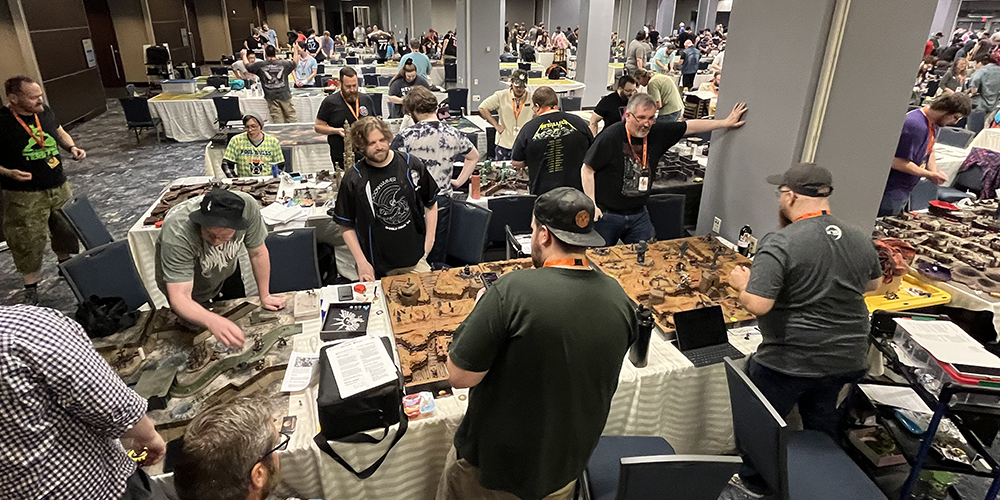
In 2025, I was tasked with running a 2-day Trench Crusade narrative event at NOVA Open. Simultaneously, my local community was fed up with pick-up games and instead craving organized play. I ended up killing two heretics with one grenade by writing the Malian Scouring, an eight game campaign set in North and West Africa where warbands look for lost gold and powerful relics.
When you begin writing your own custom campaign, you start with the foundation. Start by asking yourself important questions like: What themes do I want to capture? Where is the campaign set? What is the conflict? How can it be resolved? What makes it different? How can I make it fun for players? These are simple questions and require nothing more than simple answers. I knew I wanted my campaign set around Mali. I know that historically the Mali Empire is known for their vast riches, so maybe the campaign could be sort of a treasure hunt. I know the greedy Domain of Mammon is nearby, so they would be a natural antagonist to the wealth of Mali. Not all parties are desperate for wealth, but knowledge from the universities of Timbuktu would certainly be of interest.
It’s always good practice to do your research. In truth, I knew very little about the real life Mali Empire before I started working on the Malian Scouring (other than that one story of Mansa Musa’s famous Hajj, look it up). Mali was mentioned in the Trench Crusade lore exactly once at time of writing the campaign, so I knew that it was up to me to figure it out. Additionally, Trench Crusade is an alternative historical setting, so it’s important to approach research with a sense of subversion of historical basis. In other words: know your facts, but make it fun.
The basic research reveals that Mali was one of the greatest empires of Western Africa between the 13th and 16th centuries, with influence that reached at least as far as Western Europe and Asia Minor. By the late 14th century, Islam was likely the dominant religious practice, though there are influences from traditional African religions. The reign of Mansa Musa was considered the height of the empire and he was likely the richest man on the planet, even by today’s standards. Musa was also deeply invested in education, annexing Timbuktu into the empire and sponsoring major scholarly pursuits. The fall of the empire is typically attributed to a line of inept rulers and military pressure from neighboring states, particularly the Songhai Empire and Saadi Sultanate.
Great! We have a historical foundation, but how do we advance this into 1914 Trench Crusade? The Golden Empire of Mali is still on the map, so we know it never fell. Additionally, it appears to be strong enough to keep its Muslim population from leaving for protection behind the Iron Wall. This setting is non-colonial, at least in comparison to the centuries of atrocity committed by European imperialists in our real life timeline, so we don’t have to worry about that. In the end, I was able to safely estimate that the Golden Empire of Mali had advanced through time on heavy cavalry and a gilded bolt-action rifle. Politically, as an Islamic state, they are likely in tentative agreements with other Faithful factions of Europa and the Iron Sultanate, though remaining independent to their own interests.
In regards to a wargame, there has to be conflict, of course. Mali has vast riches, and their neighbors, the Domain of Mammon, wants it. Simple as. But this is likely always a conflict between the two, so why are we fighting in this campaign? This is our chance to flex our creativity. The Faithful of Europa probably order pure Mali gold or their advanced knowledge in exchange for other supplies or support, and that trade has to pass through the Sahara, across the Mediterranean, and into Europa. Heretics also want these supplies, so rapid strike teams have been sent to scatter the caravan while goetic ritualists summon plagues-cursed haboob storms to wipe out organic material, leaving behind glittering gold in the sun-beaten wreckage.
The Terms of Battle
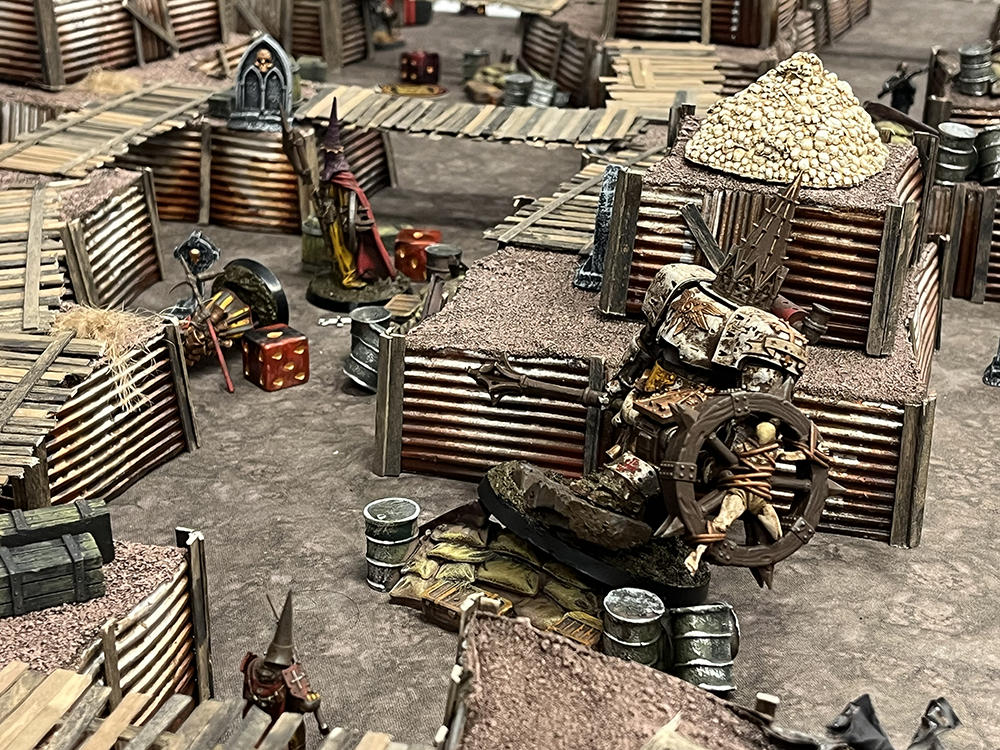
A narrative campaign finds its roots in the setting, but at the end of the day we still need to set our miniatures on the tabletop and roll the dice. The next step to writing a custom campaign is making it clear why our warbands are fighting. We could just play out a standard scenario and say our objectives are golden, but we can take it to the next level by writing a custom scenario. This could be as simple as referencing an existing mission and giving it the same colors as our Malian background. For example, the first scenario of the Malian Scouring, Rustfield, is mechanically identical to the Supply Raid scenario. However, I knew I wanted to tweak a few elements to sell the narrative that A) these lands are full of lost gold and B) it’s dangerous out here! The basic elements of Trench Crusade scenarios are:
- Forces: The models you can bring to a battle.
- The Battlefield: Terrain, objectives, and other environmental elements of the game.
- Deployment: The specifications of where you can deploy your models.
- Special Rules: Unique elements that players must utilize or overcome to reach victory.
- Game Length: How long or in what condition the game continues or ends.
- Victory Conditions: How a player scores and a winner is determined.
- Glorious Deeds: Special tasks that reward players for unique, lucky, or strategic plays.
In the case of my Rustfield scenario, I wanted to tinker with the objectives (under The Battlefield section) and add a Special Rule. Instead of standard Supply Cache, Rustfield objectives are caravan goods lost in scattered wreckage. When a model interacts with the objectives, players would roll on a table to see what’s inside, ranging from a handful of riches to blessed holy items to a deadly gaseous booby trap. The throes of battle had stirred up dormant plagues lying in the sand, reducing the armour modifier for models on the third and fourth turn of the game, a damning Special Rule that encourages careful plays early in the campaign. These are simple changes, but they’re just enough to transform a standard scenario to a completely unique experience. Though, be cautious not to go overboard; too many changes can trigger a cognitive overload in players, making the scenario an overwhelming and confusing experience. Frustration is difficult to outweigh with fun.
Scouring
I knew that a narrative foundation and a handful of unique scenarios would be fun for myself and my players, but there’s one thing that really makes a campaign so memorable: the post-battle sequence. ELITEs are crushed by the Trauma Table, infantry earn their name in the Promotion Step, and your Warband meets a world that giveth and taketh in the Exploration Step. These are moments that breathe life into your Warband, carrying their story from one battle to the next. These are the moments that last a lifetime in memory.
It’s a daunting task to tweak the Campaign Phases – they’re a fragile beast – but they can be tamed. For Malian Scouring, I added the Scour mechanic to the Reinforcements and Exploration Steps. When a player rolls Exploration Dice, players can find Clues (die result of 1) and Malian Gold (die result of 5 and 6) in addition to the results of their normal Exploration Roll. Malian Gold could be used to gild Battlekit or pay tribute to Patrons for extra boons, and Clues are used to find Timbuktu Manuscripts during a battle. Rather than drastically changing the system – removing, adding, twisting, and turning – it may be wise to engage with the less-is-more strategy of modifying or referencing existing mechanics. The Scour rule simply gives more weight to existing gears rather than adding bulk to the entire system. It’s a delicate balance, so tinker with caution.
The Fun Stuff
Eat all your veggies, but don’t forget to have a cookie, too. I want players to have a fun experience with the art I make, but ultimately I’m making a campaign that I want to play. I wrote Malian Scouring because I wanted to explore Mali, because I wanted to play a treasure hunt, because I wanted to write fun magic items, because I wanted to collaborate with my community. Make things you like to make, share it proudly, and others will like it, too.
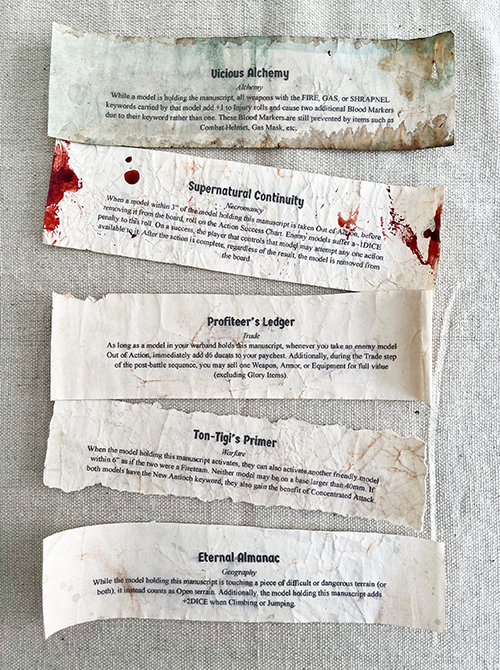
Timbuktu Manuscripts were my last attempt to dump the rest of my ideas onto the page. Players use Clues to find them on scenario objectives, immediately granting unique items that can be fought for on the spot. Starslip [Astronomy] lets the bearer Dash through space. Supernatural Continuity keeps nearby models alive just long enough for one last attack. Profiteers Ledger grants extra ducats and the ability to sell Battlekit for full value. Manuscripts offer the player a sense of real power, but can be stolen, putting a huge target on their valuable models. They’re simple and fun, a chance to play with the toys you dream about in your wild version of Trench Crusade; the cookie after your vegetables.
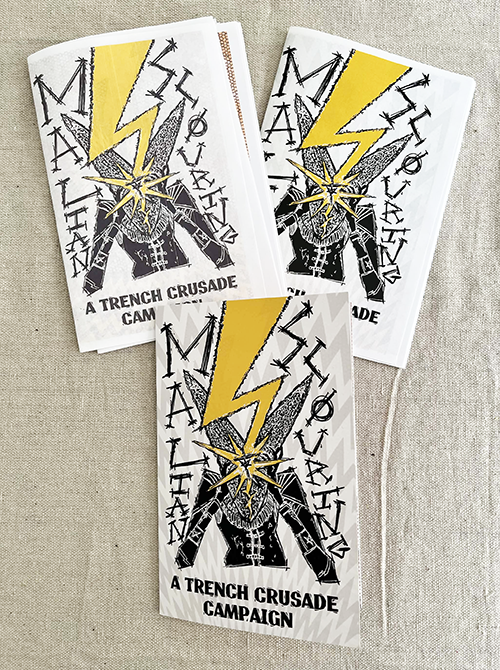
The true goal, I think, is sharing creativity with my community. Kitbashing themed Mali and Mammon warbands, drawing a sticker to give to players, sharing stories of the trenches with the game club, putting together a rad zine with a friend. Art begets art and joy begets joy. Make things for a friend and they will make for you. Run a campaign and you’ll play another. Do and make, that’s the fun stuff.


Sammie Dae
Sammie Dae is a game designer for Trench Crusade. Her experience is grassroots: setting up weekly game nights, running campaigns and events for local clubs, writing silly scenarios and fun homebrew rules for her friends, and suffering the “forever GM” curse. She’s been a volunteer Observer since 2024 and has organised major Trench Crusade narrative events at AdeptiCon and NOVA Open. She’s dedicated to her community, supporting human creativity, and ensuring everyone has a place in the hobby.