



All Out War: Multiplayer Rules
by Jervis Johnson
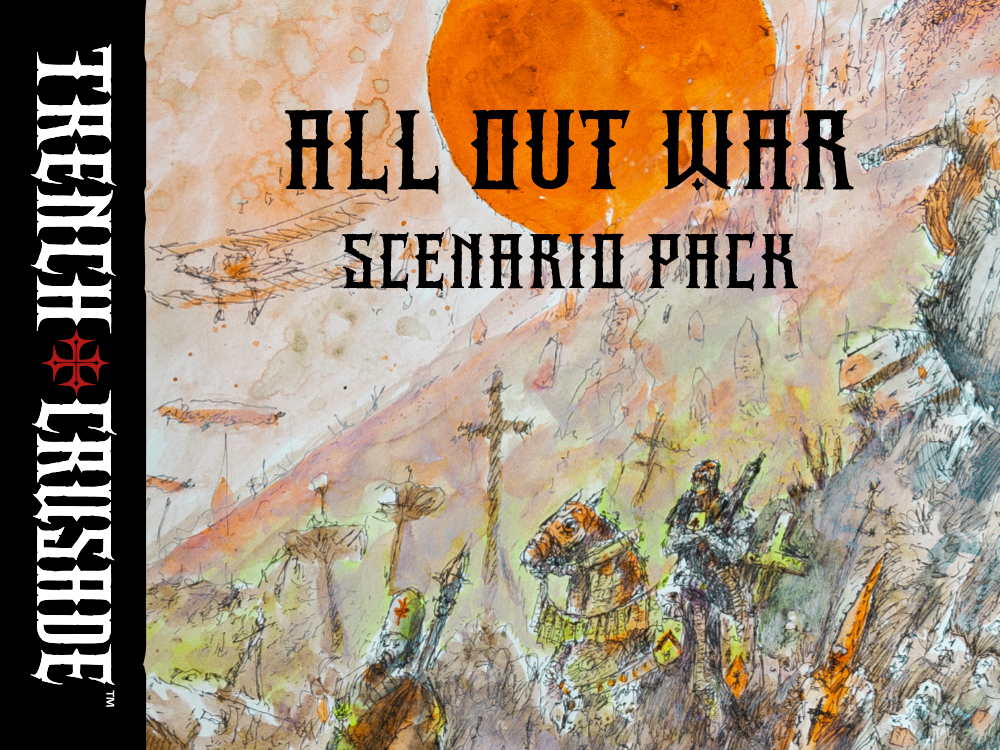
When we wrote the Trench Crusade rules, we decided they should focus on two-player games. However, everyone in the rules team loves playing multiplayer games, too, and so right from the start, we planned to release a set of multiplayer rules for the game. All Out War is the result, allowing you to play Trench Crusade games with three or more players. It includes all the new rules you need to play multiplayer games, along with three brand new multiplayer scenarios.
What you need to play
The most important change to the core Trench Crusade rules is the addition of a standard deck of playing cards, which is used to determine the order of play and to determine who wins a roll-off.
In a multiplayer game, cards are used to determine the initiative and order of play. In the Initiative Phase, each of the players is dealt a card face-up, and in the Activation Phase, the players Activate their models in the order of the value of their cards, from high to low. Once all the players have Activated one model each, the sequence starts again with the player with the highest card, and so on until all the players have Activated all of their models and the Activation Phase ends.
Cards are also used to resolve roll-offs, which are replaced with making a ‘draw’. As the name implies, to make a draw, each player draws a card from the deck, and whoever draws highest wins the roll-off. Simple!
The scenarios
These simple changes are backed up with three multiplayer scenarios. The first of these is called Looters and allows three to eight players to fight a multiplayer battle in which each player is out to capture as much loot as they possibly can. Looters is a great scenario to choose if you and your friends just want to throw down and fight a battle royale, all against all!
The second scenario is called Brothers-in-Arms and is for exactly four players that are split into two teams, with two players on each team. The team that scores the most victory points wins the scenario, with the two players on the team being joint winners. Brothers-in-Arms is a great way to play one-off games with four players, but it has been primarily designed to allow event organisers to run Trench Crusade tournaments using the popular ‘doubles’ format, with the players taking part in two-player teams rather than individually.
The final scenario is called Alliance & Betrayal, which can be played by three or four players. As its name implies, this scenario is all about making temporary alliances and then stabbing you ally in the back when they least expect it! It also includes rules for using a second pack of playing cards as the Betrayal deck. Players are dealt cards from this deck at the start of each Turn and can use them to carry out all kinds of dirty tricks, like bribing another player to do what you want or conning them into giving you 1 of their victory points.
To sum up, All Out War opens up a huge variety of new ways to play Trench Crusade. I highly recommend you give the rules a try as soon as you can!

Jervis Johnson
Before joining Factory Fortress as a project lead and rules designer, Jervis Johnson worked for Games Workshop as a games developer for almost 40 years. His first game design was Blood Bowl, released in 1987, which combined elements of American Football with fantasy monsters to create a unique and completely over the top board game. After that, Jervis was involved in the design and development of nearly all of Games Workshop’s boxed games, rulebooks and army books, and he was a regular contributor to White Dwarf magazine. Jervis left Games Workshop in 2021 and now works as a game design consultant and independent game designer.