


The Altar of Leviathan
In 1865, the Heraklion earthquake struck the northern coast of Crete, and its devastating shockwaves were felt all across the hellfront of Anatolia, the Levant, and North Africa, wiping hundreds of settlements from the map in a single night of terror. Hundred-foot high waves surged across the Mediterranean, causing untold devastation before being funnelled into the Gulf of Alexandretta, where, by the time it drew near the town of Dorythol, the compressed tidal wave was a thousand feet high. Its people gathered on the shore to witness their onrushing doom, praying for God to save them…
And then, a miracle.
The townsfolk watched in astonishment as the wave slowed and eventually halted half a mile from the shoreline, a titanic wall of water held back by the power of the Almighty. The water foamed and seethed like a beast denied its prey, and when the wave retreated back to the deep ocean, a rocky landscape strewn with half-devoured corpses and the debris of faraway lands was revealed.
On the exposed seabed, the people of Dorythol discovered an ancient temple of such strange form and unnatural scale that most would not dare approach for fear of their mortal souls. It lay canted at a strange angle, ripped from unknown foundations and carried on a great slab of greenish black stone no quarryman could name. Those reckless few who dared explore the ruins found a great obelisk of the same greenish black stone that resembled a serrated tooth, but one of such scale that it could not possibly be from anything living. All could feel the power emanating from the stone and fell to their knees before what must surely be a gift from God. Before the waters returned, the obelisk was dragged from the temple and set atop a high hilltop in the craggy heights behind the town. It became known as the Altar of Leviathan, a holy wonder that was never spoken of in the presence of outsiders.
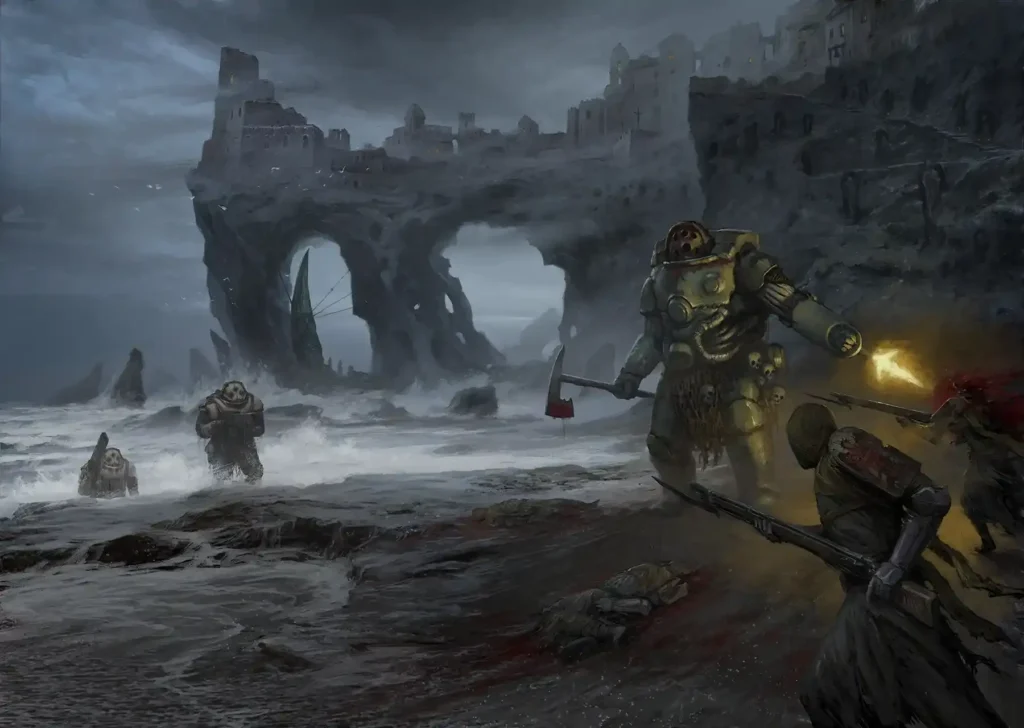
In the years that followed, no matter how the fighting against Hell waxed and waned, Dorythol was spared the fire and fury of battle, with the forces of the Faithful and the Damned seemingly all but blind to its presence. In thanks for this great mercy, votive offerings were made at the foot of the altar: food and wine, gold and livestock, for it seemed that the power that had saved them from the tsunami was still potent and ever hungry. But in 1871 AD, the Heretic submarine, Congregant of Mammon, surfaced offshore, and armoured killers marched towards the town with murder in their hearts. In desperation, the townsfolk once again turned to the altar, this time offering the most profane sacrifices of their own flesh and blood in return for salvation. No one speaks of that night now, but when the submarine’s carcass was later discovered drifting off the easternmost tip of Cyprus, it was little more than a gutted hulk, its crew missing and its internal bulkheads painted crimson with their blood.
Today, Dorythol still stands untouched by the horrors of war, and, as they have done on the darkest night of each year, the townsfolk lay yet another unspeakable sacrifice upon the altar before hastily retreating to their homes, where every door is painted with strange symbols none can remember learning and sealed fast with iron nails. On that dreadful night, strange fogs wreath the town and the muffled tread of heavy, wet footfalls can be heard on the cobbles outside. Fearful men and women cower by their cold hearths, hoping those beyond will keep walking, but with every sunrise, one home stands empty, the living souls who once occupied it taken by unknown captors and never seen again.