



Castigators
by Andy Chambers. Art by Loïc Muzy.
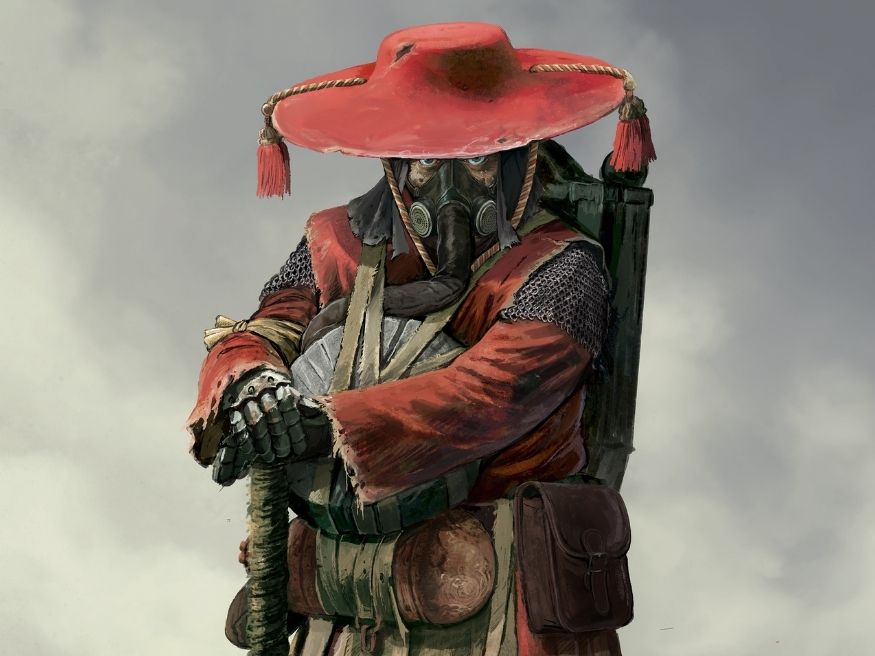
This week, we’re revealing more lore about the Castigators. These implacable leaders of the Trench Pilgrims guide their fanatical flock with inspiring words of spiritual wisdom and the goading lash of the whip.

Castigators can be found in the ranks of almost every pilgrimage. They serve an essential role in being the first and the foremost to provide direct spiritual guidance and vigorous moral correction to the milling hordes of their fellow pilgrims, acting not unlike the non-commissioned officers of a regular military force. The path of righteousness is not always easy to follow, and transgressions made by pilgrims must be promptly punished to remind supplicants that they must always fear God’s Judgement more than the enemy or even death itself. As befits the Castigator’s role they are often both imposing in stature, dour in dress and demeanour, and possessed of stentorian voices capable of penetrating even the most enraptured ears.
All Castigators bear a ceremonial scourge of some kind as their badge of office. The precise form of this instrument of correction punishment can vary greatly depending on the Castigator’s patron saint and orthodoxy. For example, Methodians employ metal rods, the Dunstanians use hempen ropes, and the Marians’ preference is for red-hot irons. The Lazarist Castigators of the Sacred Affliction commonly use scourges of braided leather, or of knotted hair shorn from their flock.
The symbolism of the instrument is always singular whatever form it takes: it is the Whip of God, both a reminder and a physical manifestation of the righteous metaphysical punishment that is in store for all sinners in the eyes of the Lord. For those who have dedicated themselves to be martyred for the everlasting glory of God it is a necessary and welcome tool, used to expose and exorcise the weaknesses of the body when confronted by the temptations of sin. Pride, envy, wrath, gluttony, lust, sloth, and greed can seep all too easily into even the most pious mortal soul. The watchful Castigators always stand ready to discover any trace of sin and to vigorously drive it out.
On the march Castigators keep discipline within the ranks of the pilgrimage and issue the War Prophet’s commands to the faithful. They act as the prophet’s confidants and personal confessors, shriving them and granting absolution for any of their sins which do not fall under the auspices of the Apostolic Penitentiary. Castigators also take daily confessions from the faithful, typically after vespers and by necessity en masse if the pilgrimage is a large one. Depending on the degree, transgressions made by the pilgrims can be absolved through vows, additional duties, privation, enforced fasting, or corporal punishment.
In the latter case, the individual orthodoxy and patron saint of the pilgrimage also greatly influence the degree and nature of the punishment. Flogging, branding and even mutilation are widely accepted as forms of physical absolution for most pilgrimages, but some disagree. Methodians abhor gratuitous and barbaric practices, and will prefer exile or incarceration over anything more serious than the most symbolic of physical correction. Naturally, Marians prefer to use severing and branding, while Dunstanians favour pressing. Lazarist Castigators assign the weight of the millstone given to leper-pilgrims to carry as their symbolic weight of sin, so among that horde a wayward pilgrim will receive a yet weightier stone to bear.
In the case of repeated or serious transgressions, a Castigator may invoke a reduction to the ranks of the Ecclesiastical prisoners, or even immediate martyrdom for final judgement to be made by God. Heresy or blasphemy are universally met with instant excommunication and execution without last rites or sanctified burial. The sin of personally taking up the cause of the Almighty and then turning aside from the path is among the most reprehensible to a Castigator, no matter what their creed, and they meet it accordingly. In a more pastoral role, Castigators also act as the guardians of the pilgrim’s shrine and its sacristy and they are often the pilgrimage’s acting quartermasters as well.
In battle many Castigators lead their flock from the front, but in better equipped pilgrimages Castigators may stay in a supporting role to direct the pilgrims’ righteous but at times unruly fury against the foe with more precisely directed volleys. In either role Castigators constantly remind the pilgrims of their ultimate duty to the Kingdom of Heaven, and absolve any temporary lapses on the spot with suitable verbal encouragement and corrective application of the Whip of God. Inevitably such a prominent presence makes Castigators prime targets for Heretic snipers and assassins, so they may wear armour or bear trench shields for protection. Some pilgrim dogmas eschew such protections entirely to demonstrate complete commitment to God’s plan, but even these Castigators may utilize martyrdom pills and holy icons to ensure they will not fall before the battle is won.
Although they are confirmed members of the clergy as appointed by a pilgrimage, few Castigators are students of the innumerable parish and metropolitan seminaries of Europa. Indeed their role falls outside the doctrines of the Unified Church, which does not officially condone pilgrim processions. In some cases Castigators may barely stand within the broader Orthodoxy of Faith at all, as is demonstrated by the notoriously brutal Castigators of the Cavalcade of the Tenth Plague.
Most Castigators refer to their purpose as a “calling” that came to them later in life as a result of their natural disposition or personal experiences they typically cite as receiving revelations from the Lord to set about His work “at last”. Combat veterans, non-commissioned officers, ship’s bosuns, prison wardens, schoolmasters, deacons, postmasters, executioners, torturers, farmers, and police officers have all been noted as making effective Castigators with little more than additional biblical studies.
Those from other walks of life usually require a more rigorous period spent as an acolyte to a full-fledged Castigator to learn the ropes, in many cases literally. There are whispered rumours that Castigators are, in fact, Ecclesiastical Prisoners who survived martyrdom or Heretics forgiven by the grace of God, but those who speak them are careful not to do so anywhere where a Castigator might hear.
For those Pilgrimages that do follow the official Church doctrine, confirmation of a Castigator into the clergy can be made in the field via a writ of authority from the ranking cleric. The preferred method is to register the confirmation with Rome to ensure the Castigator’s name is added to the ledgers of the righteous that rest in the Vatican Archives. Orthodox Castigators will strive hard to ensure that their flock is sufficiently purified that they can one day make a personal pilgrimage to the Holy See and receive confirmation in person. Few succeed in this goal; either their daily God-given burdens occupy all of their time or they are martyred long before the opportunity arises. Other Castigators have little care for notions of propriety dictated from afar by the Supreme Pontiff in Rome and are content to pursue their cause and their faith unmarked and unknown save by the eyes of God.
Because of this the sight of a hard-bitten veteran Castigator from the frontlines on the streets of any city will draw guilty whispers and averted glances from some, and a huge upwelling of faith in others. Many a pilgrimage has begun with just a single Castigator and a worthy Prophet that they found in the hinterlands and persuaded to lead the faithful to battle. From these first small stones, a righteous avalanche grows.

Andy Chambers
Andy Chambers is a games developer for Trench Crusade and a veteran writer and games designer with over thirty years of experience, best known for his work in the Warhammer 40,000 universe. From 1990 to 2004, he worked as lead designer for three editions of Warhammer 40,000 and a variety of other Games Workshop titles. In 2005, Andy moved into PC gaming to work on Starcraft 2. Since 2009, Andy has worked as a freelancer designing games and writing for a variety of publishers, with notable works including Starship Troopers, Dust Warfare, Dropfleet Commander, and a range of titles for Warlord Games.