



The Ruins of Nineveh Novus
by Graham McNeill. Art by Artem Demura
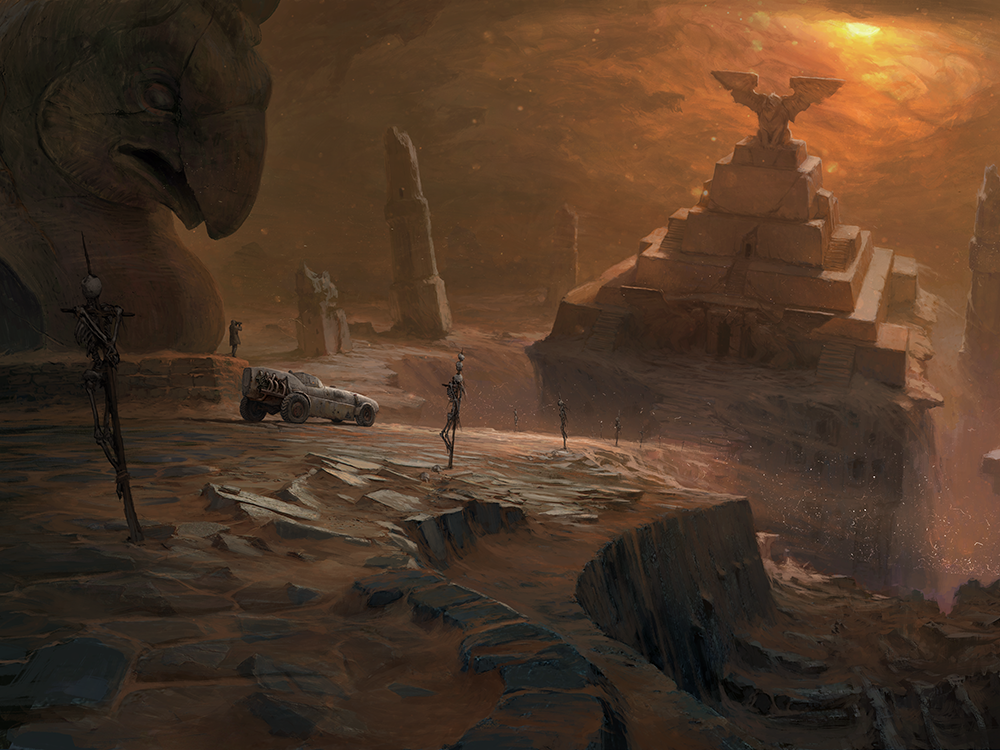
Nineveh was once the largest city in the known world, the seat of bloodthirsty Assyrian emperors, and a place famed for its wretched wickedness. The city’s doom had been foretold by the Prophet Saints Jonah, Nahum and Zephaniah, who warned that God would, “Stretch out his hand against the north, destroy Assyria, and make Nineveh as dry as the wilderness.”
Many chose to escape this foretold destruction by fleeing west to settle in the ruins of a forgotten city northwest of Aleppo. Foremost among these refugees were dangerously obsessed scholars who had unlocked the mystic tablets of King Solomon and who secretly bore grimoires and cuneiform tablets of dark magic first carved in ancient Mesopotamia. In their arrogance, they saw themselves as the spiritual heirs of the ancient mages of Egypt who had fled before Alexander the Great’s invading hosts – heedless that the very texts they revered were the source of God’s coming wrath.
With the power of hermetic sorceries, the scholars gradually rebuilt the ruins into a subterranean city they dubbed Nineveh Novus. They wove incantations to conceal their city behind flesh-scouring sandstorms, and yoked demons of the desert to slay any who came near, certain this would protect them from both the wrath of the Almighty and the covetous eyes of kings. Over the following centuries, it appeared they were correct, and vast libraries were built to contain the wealth of knowledge that their communications with higher beings revealed. Many repositories were filled with mystic artifacts captured by the Knights of Solomon, a martial order established to retrieve objects of magical significance by any means necessary and return them to Nineveh Novus.
Arcane powers had kept the sorcerers of the desert hidden for over a millennia, but some dooms are inevitable and inescapable. In their hubristic quest to unlock the power of the divine, the sorcerers had profaned the angelic and the demonic in an affront to both Heaven and Hell, and such insults can never be forgiven. When the end came to Nineveh Novus, it came in a single night of screaming terror in 1272 AD, when the wrath of both kingdoms struck with all the fury unleashed on Sodom, Tyre, and Samaria combined. Nineveh Novus was burned from above and below for seventy-two days, and barely a single soul survived that night of wrath.
Warding sorceries woven into the rock allowed the city itself to survive, though the seismic wrath of the earth expelled many of its sunken chambers back up to the pitiless light of the surface. Yet much of what its deluded scholars illuminated and its knights recovered endures in its shattered libraries and half-buried reliquaries. Unholy monsters, brought into being by foul incantations and experimented upon by the scholars, are said to stalk its maze-like passageways, seeking vengeance on their former torturers. A handful of the unnaturally long-lived scholars, driven mad by their doom, still linger in the ruins, twisted into deranged lunatics by the unleashed cataclysm. Beyond the dead city, the demons of the desert still remain as vengeful djinn, and to hear their inhuman shrieks is to know that death is approaching.
Farther out, at the very edge of the desolation, the sniper stylites of St. Simeon watch over the ruins from atop their great spires, ready to kill anything that seeks escape from below and to warn away any who risk their mortal souls by approaching the cursed city. Despite this, treasure seekers and questers after forbidden knowledge have sometimes managed to evade the stylites’ vigilance to delve the ruins in search of its secrets. Few ever return from these foolish expeditions, and those that do are changed beyond recognition by what they have seen beneath the sands.
Graham McNeill
Graham is an award-winning Scottish author, screenwriter, and games-developer who has written for numerous global gaming worlds, including League of Legends, Warhammer, Starcraft, and Arkham Horror. His novel, Empire, won the David Gemmell Legend Award for Best Fantasy Novel, and four of his novels in the Horus Heresy series are New York Times best-sellers. Recently, he worked on the Emmy Award-winning Netflix animated show, Arcane, and is a lifelong collector and player of every kind of game you can imagine.